Moonstone Beach 12/23

A solid week of rain dashed our hopes of seeing the lunar eclipse on the 20th but a break in the heavy rain on the 23rd gave us a chance to get outside. We decided it was time for a visit to Cambria, California and Moonstone Beach.
Here are some reviews of the beach and other folks' impressions. Now, if you live in a place that is having cold nasty weather this time of year and are feeling envy just hold on a second. Yes, there are fantastically beautiful days like the one pictured above that come along in winter but you have to take note that those are the only days everyone runs outside to take pictures. The recent wet is nothing compared to freezing rain and snow but don't get the idea that everyday looks so blue. And if you come to visit in the summer, HA! the central coast will likely be socked in with a thick cold fog. These fantastic clear (but chilly with wind) days are often in the middle of winter when the marine layer has been blown away by a storm, and indeed the next day was gray and drizzly again.

So, we took our shot at the pebbles while the getting was good. If you want to go pebble hunting or tide pool gazing be sure to check the
tide forecast. Arriving at the beach and finding no beach can be disappointing and tides here can be high enough to completely obscure the pebbly sand and tide pool rocks. I took a look and found that high tide was to occur at 11:40ish in the am and would crest at +6 feet. Gads! good thing I checked. Arriving in the morning we'd be out of luck. Instead we waited until after lunch and had an ever expanding beach to play on, but we'd miss out on the very wide low tide beach that makes for the best pebbling and tide pool gazing.

So, what's all this business about pebbles? you say. Well, Moonstone beach is so called for the jumble of marvelous hard bits of stone tumbled on the shore. The majority are chert, a fine grained sedimentary silica rich stone that is hard enough to resist being pulverised right away in the surf. It comes in an array of colors and makes for dazzling pebble picking. Just a few minutes spent looking near your toes will turn up treasure.

According to the name of the beach there are moonstones to be found. I'm not enough of a geologist or gemologist to know if I have ever seen a moonstone but I hear tell that tossed in with all the chert there are many bits of quartz, nephrite, and rare bits of jadeite. These last two are the source of jade gemstones. Beware, you may be bitten by the jade bug and go ape for the green bits, however I think the melange of colors in the chert (much of which is green too) is more interesting. The pretty green stones are very abundant here but few have the translucent quality that most expect of gemstones. I know that true nephrite is harder than chert and jadeite is harder still so a simple beginners' test if you insist on finding jade is to try scratching the stone with steel. A dull pocket knife will do (it'll be dull soon enough grinding it on hard stones). Bring a loop or other magnifying glass and look at your scratches. If that green stone you've got is cold on your cheek, has some nice sparkly translucence, and when you look close the scratch is actually bits of steel ground off onto the stone then there's a good chance you have some jade. To be absolutely certain you have to get technical and measure the stones specific gravity. Not hard to do if you have a good graduated cylinder and a chemist's balance scale, but all that is beyond me.

I just like lookin' at 'em, and if I end up taking one home it's usually one with wild mottled colors. I'm just not ready to catch the jade bug.
What's the source of all these pretty rocks? Well, the polishing in the surf helps, but all the hard bits of stone come from the
Franciscan Assemblage. A geological leftover, predating the San Andreas fault, that is mashed up all along the California central coast. Another favorite pebble spot is Jade Cove in Big Sur. I have not visited this one so I can't vouch for it but I suppose the name is promising. Geologists think that much of this coastal stuff is sedimentary material from the Pacific Ocean floor that was scraped up and packed onto a coast that was at that time riding over a subduction zone. For more on this and other Southern and Central California geology tidbits I highly recommend
Geology Underfoot in Southern California.

The same day we had another surprise payoff from the week long drenching, a wild mushroom show, but that will have to wait for the next post.


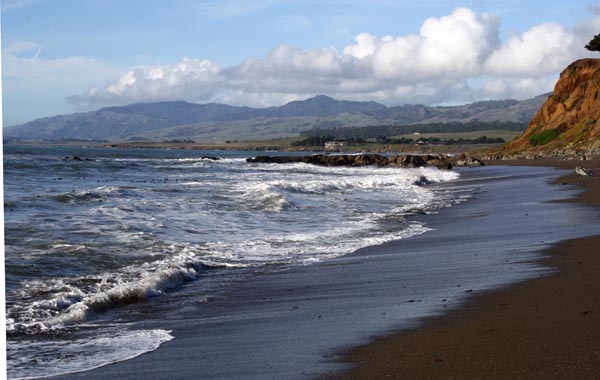 A solid week of rain dashed our hopes of seeing the lunar eclipse on the 20th but a break in the heavy rain on the 23rd gave us a chance to get outside. We decided it was time for a visit to Cambria, California and Moonstone Beach. Here are some reviews of the beach and other folks' impressions. Now, if you live in a place that is having cold nasty weather this time of year and are feeling envy just hold on a second. Yes, there are fantastically beautiful days like the one pictured above that come along in winter but you have to take note that those are the only days everyone runs outside to take pictures. The recent wet is nothing compared to freezing rain and snow but don't get the idea that everyday looks so blue. And if you come to visit in the summer, HA! the central coast will likely be socked in with a thick cold fog. These fantastic clear (but chilly with wind) days are often in the middle of winter when the marine layer has been blown away by a storm, and indeed the next day was gray and drizzly again.
 So, we took our shot at the pebbles while the getting was good. If you want to go pebble hunting or tide pool gazing be sure to check the tide forecast. Arriving at the beach and finding no beach can be disappointing and tides here can be high enough to completely obscure the pebbly sand and tide pool rocks. I took a look and found that high tide was to occur at 11:40ish in the am and would crest at +6 feet. Gads! good thing I checked. Arriving in the morning we'd be out of luck. Instead we waited until after lunch and had an ever expanding beach to play on, but we'd miss out on the very wide low tide beach that makes for the best pebbling and tide pool gazing.
 So, what's all this business about pebbles? you say. Well, Moonstone beach is so called for the jumble of marvelous hard bits of stone tumbled on the shore. The majority are chert, a fine grained sedimentary silica rich stone that is hard enough to resist being pulverised right away in the surf. It comes in an array of colors and makes for dazzling pebble picking. Just a few minutes spent looking near your toes will turn up treasure.
 According to the name of the beach there are moonstones to be found. I'm not enough of a geologist or gemologist to know if I have ever seen a moonstone but I hear tell that tossed in with all the chert there are many bits of quartz, nephrite, and rare bits of jadeite. These last two are the source of jade gemstones. Beware, you may be bitten by the jade bug and go ape for the green bits, however I think the melange of colors in the chert (much of which is green too) is more interesting. The pretty green stones are very abundant here but few have the translucent quality that most expect of gemstones. I know that true nephrite is harder than chert and jadeite is harder still so a simple beginners' test if you insist on finding jade is to try scratching the stone with steel. A dull pocket knife will do (it'll be dull soon enough grinding it on hard stones). Bring a loop or other magnifying glass and look at your scratches. If that green stone you've got is cold on your cheek, has some nice sparkly translucence, and when you look close the scratch is actually bits of steel ground off onto the stone then there's a good chance you have some jade. To be absolutely certain you have to get technical and measure the stones specific gravity. Not hard to do if you have a good graduated cylinder and a chemist's balance scale, but all that is beyond me.
 I just like lookin' at 'em, and if I end up taking one home it's usually one with wild mottled colors. I'm just not ready to catch the jade bug.
 The same day we had another surprise payoff from the week long drenching, a wild mushroom show, but that will have to wait for the next post.
 The a-go-gos love the beach, but we are not the sort to lay in the sun. We say, "good morning," to the ocean when we find ourselves there at dawn. We'll have breakfast on the cold damp beach and watch tiny crabs to kick the loose sand out their front doors. Early morning or not we don't linger when the sun is too bright. Overcast cool days are the ones to spend watching the waves.
 For a Venice Beach ride we'll arrive when early-bird joggers and dedicated surfers are our only company, while the people who spent the night in their cars are still asleep. With so few people out we don't get the usual comments about our screwy lookin' bike helmets. Our ancestors come from the land that the sun forgot and we must work hard to maintain our pallor. We're usually home taking a nap by the time the sun worshipers are out.
 It's much easier to feel like you're the only one who knows about a place when there is no one else there. Arriving really early or going on cloudy, cool days makes the beach a new discovery. Sometimes the tide has been high enough overnight that yours are the first footprints. Cool days when the other primates don't want to be on the beach is when all the critters come out. Cormorants dive for fish close to shore and the kill deer stroll the lines of froth and sea weed.
 Even when we visited friends in Maui for our honeymoon, we couldn't be bothered to sun bathe. I would be up early for a walk in the mornings, or we'd sit on the beach to wait for the sun to take its evening bath.


